Stop guessing the logic.
See DSA in motion.

Break out of tutorial hell. A structured, visual curriculum that builds real intuition — from arrays to advanced graphs — taught with cinematic animations and clean, production-grade code.

32Animated lessons
30+Core patterns
365Days of access

Taught by an IIT Bombay CS graduate · GATE AIR 75 · ex-Oracle & Microsoft · 1500+ LeetCode problems solved

Try it yourself

Stop tracing code in your head.
Watch the pointers move.

This is how every lesson feels. Every move is animated and explained as it happens. Press play, or step through it at your own pace.

Why animation

A wall of code vs. a picture that moves

Most students quit halfway because they're forced to simulate every loop and recursive call in their head. We do that work for you.

def pop(heap):
  x = len(heap) - 1
  if x < 1: return None  # is heap empty?
  y = heap[0]
  heap[0] = heap[x]
  heap.pop()
  a = 0
  while True:
    l = 2*a+1
    r= 2*a + 2
    if (l < x and heap[l] < heap[a]) or
      (r < x and heap[r] < heap[a]):
      if l < x: tmp = l
      else: tmp = r
      if heap[tmp] < heap[a]:
        swap = heap[a]
        heap[a] = heap[tmp]
        heap[tmp]=swap
      a = tmp
    else:
      break #exit loop lol
  return y
is a the parent now? left or right child? wait… why tmp?
✕ The traditional way

Static code + a 20-minute lecture

You're left mentally simulating how a while loop updates a pointer or how recursive calls stack up. It's exhausting — and it doesn't stick.

✓ The animated way

Every shift, swap and rotation — animated

The same heap pop, as you'd see it in the course: the logic and the visuals move together, so you see exactly which node is affected and why. No guesswork, just clarity.

Core pillars

Built on three ideas

Cinematic animations

Complex rotations and traversals broken down frame by frame, so you see the algorithm instead of imagining it.

Production-ready code style

No competitive-programming shorthand. Readable, well-named, scalable code that would pass a real code review.

Pattern-based learning

Don't memorise 500 random problems. Learn the ~30 underlying patterns that unlock hundreds of them.

Patterns over problems

Recognise the pattern, and the problem solves itself

Every module ends with you spotting the pattern behind a problem before writing a single line.

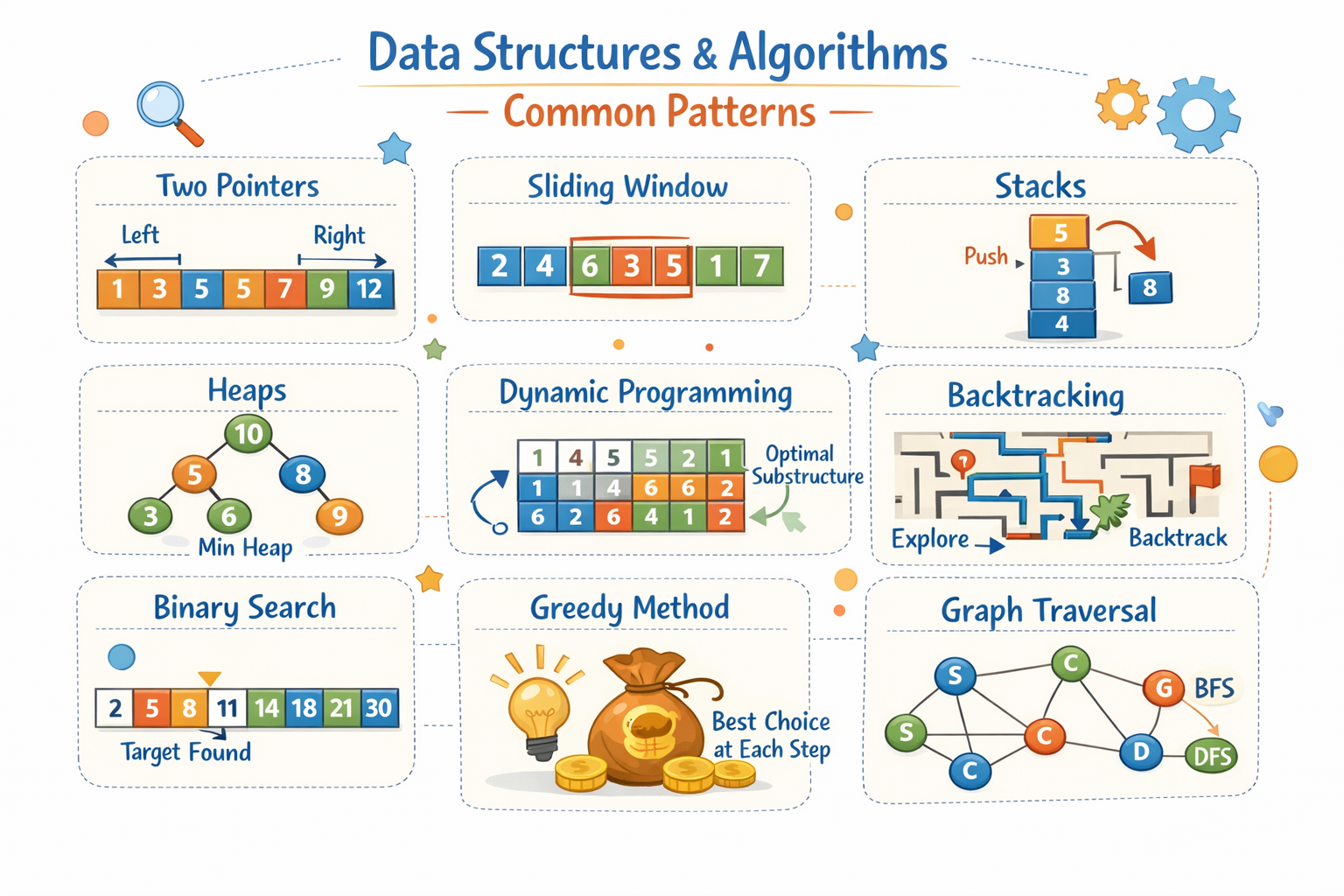
  • Two Pointers & Sliding Window for array and string questions
  • Heaps & Stacks for "next greater" and top-K problems
  • BFS, DFS & Union Find for anything that looks like a network
  • DP & Backtracking for choices, paths and optimisation
Illustrated overview of common DSA patterns: two pointers, sliding window, stacks, heaps, DP, backtracking, binary search, greedy and graph traversal
The curriculum

From foundations to mastery

Four stages, each building on the last. You always know where you are and what's next.

Linear Foundations

  • Arrays
  • Binary Search & its applications
  • Linked Lists
  • Hashing

Problem-Solving Patterns

  • Two Pointers
  • Sliding Window
  • Stacks & Queues
  • Heaps (Priority Queues)

Trees, Graphs & Non-Linear Logic

  • Binary Trees & BSTs
  • BFS & DFS Traversal and connectivity
  • Topological Sorting
  • Graphs on Grids
  • Union Find
  • Dijkstra Shortest paths

Advanced & Hard Algorithms

  • Dynamic Programming
  • Backtracking
  • Tries (Prefix Trees)
  • Intervals & Greedy
  • Segment Trees Special topic
  • KMP Special topic
The wall

Most students get lost at graphs. Here's why.

Arrays and lists keep data in a neat, predictable line. Graphs model the chaos of the real world — networks, social connections, maps — and that's where linear thinking stops working.

01

Visual overwhelm

Unlike an array, a graph looks like a tangled web.

02

The recursion trap

DFS and BFS lean heavily on recursion and queues you can't see.

03

The implementation gap

Understanding shortest paths is easy. Writing the adjacency-list code is where people quit.

How we fix it: by the time you reach graphs, you'll treat them as a collection of small, repeatable patterns. And if the web still feels tangled, we hop on a call with a whiteboard and untangle it together.

// before: the tangled web

Akshay, the course instructor
IIT BombayComputer Science graduate
About me

Driven by a passion for teaching

I'm Akshay, a Computer Science graduate from IIT Bombay with an All India Rank 75 in GATE. I've built software at Oracle and Microsoft, and I'm currently an engineer at Google. Across all of them I've seen first-hand how a deep understanding of DSA separates good engineers from great ones — elite teams don't hire people who memorise solutions, they hire people who can architect logic.

I practise what I teach: I've solved 1500+ problems on LeetCode, including 236 Hard ones, and shared many of my solutions with the community.

I built this course to bridge the gap between classroom theory and the rigour required at the highest levels of software engineering. You bring the dedication; I'll bring the roadmap, the rigour and the support to get you to the finish line.

  • IIT BombayComputer Science graduate
  • AIR 75GATE (Computer Science)
  • Oracle · MicrosoftPrevious experience
  • 1500+LeetCode solved · 236 Hard
Student stories

Hear from our students

Took the course, the Visual Lab or a webinar? Tell others how it went.

Write a review
FAQ

You've got questions. We've got answers.

What makes this course different from other DSA courses?

Most courses rely on static slides and messy competitive-programming code. We use high-fidelity animations to show exactly how data moves in memory, and teach the clean-coding principles used at top tech companies. You won't just solve problems — you'll write professional-grade software.

How do I enroll and pay?
  1. Open the course page and click Buy now.
  2. Log in or sign up, then pay securely with UPI, card, netbanking or a wallet (Razorpay).
  3. Your lessons and visual labs unlock instantly, with access for one full year.

Prefer to talk first? Message us on WhatsApp and we'll help you enroll.

Can I buy only the visual lab?

Yes. The Visual Lab plan (₹3,999 ₹2,799) opens every lesson's interactive animation for 365 days, without the lesson videos. Buy it from the Visual Lab or under the price on the course page. The full course (₹7,499 ₹5,024) includes the visual lab too. Already have the Visual Lab? Upgrade on the course page and the unused months of your lab are taken off the price; your videos and lab then run together for a full year.

Do the course videos use the Visual Lab?

The recorded lessons have their own animations, the same ones you see in the free previews on YouTube. The interactive Visual Lab comes with the course as a separate companion for each lesson, so please watch a few previews before you buy the recorded course. Live batches are taught with the Visual Lab itself.

Is there a refund policy?

The course and the Visual Lab are digital products with instant access to all content, so we don't offer refunds on them. Watch the free previews on YouTube — or try the live visualizer above — to make sure the teaching style suits you. Live batches are paid one month at a time (or all months at once, where paying in full is offered); a paid month isn't refunded, and if we ever cancel a batch, every paid month that hasn't started is refunded. A discount, like an early-bird price, applies only while it's on, and a lower price later isn't a reason for a refund. Details are in our Refund & Cancellation Policy.

What do I need to know before starting?

Only basic syntax in one major language (C++, Java, Python or similar). If you can write loops, if-else statements and functions, you're ready. We build all the complex logic from scratch.

Who is this course for?
  • Final-year college students building a rock-solid foundation and a professional engineering mindset before entering the industry.
  • Working professionals (1–10 years) levelling up their DSA or moving into senior roles where optimisation and clean code are mandatory.
Which programming language is used?

The logic and animations are language-agnostic. Clean-code implementations are in Java, whose readable syntax transfers easily to C++, Python and more.

Ready?

Never feel "lost" in DSA again.

Get all 32 animated lessons and a year of access for just ₹7,499 ₹5,024, or the full Visual Lab on its own for ₹3,999 ₹2,799.